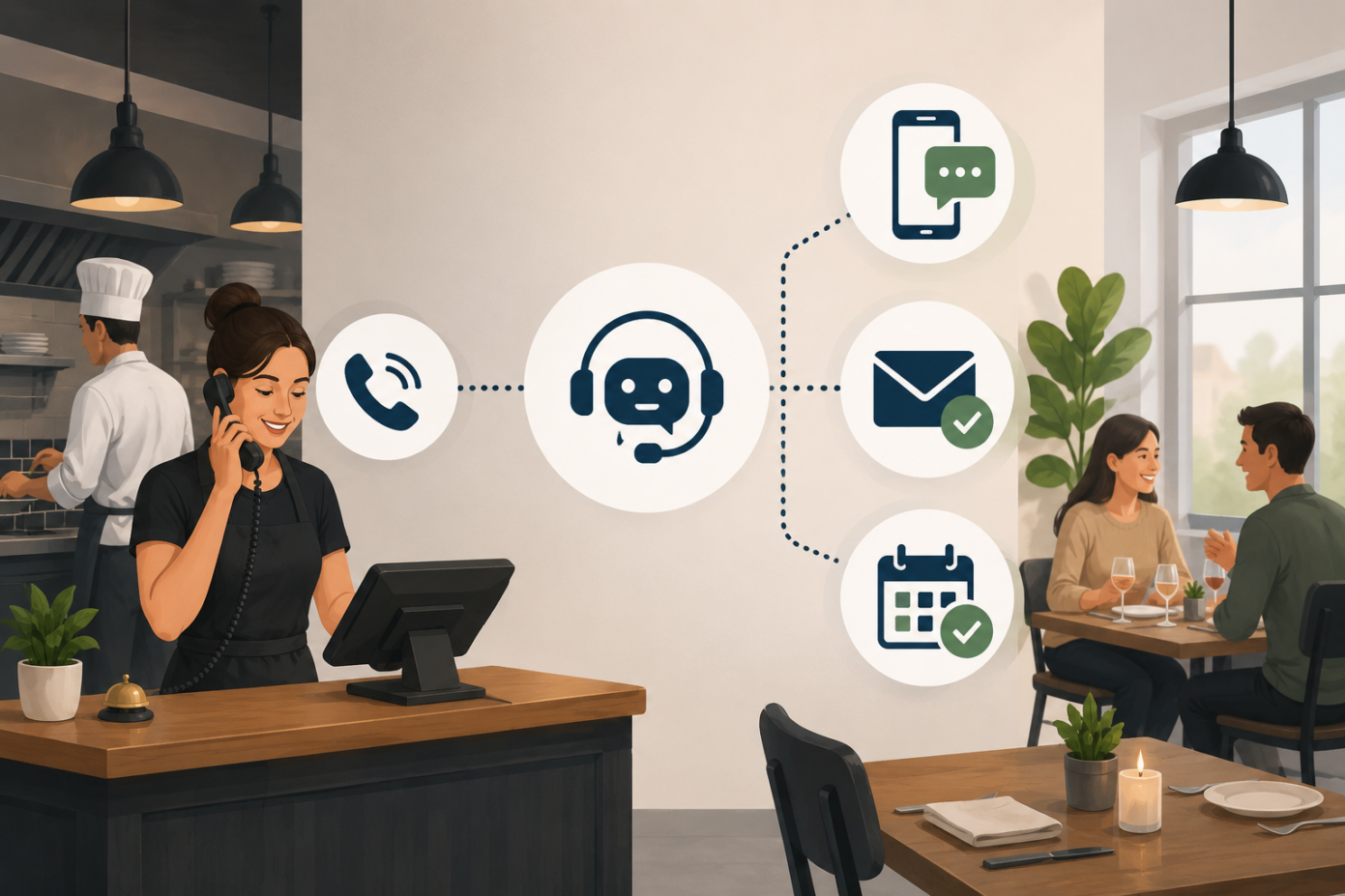
Modern restaurant phone systems are no longer just a phone bolted to the wall near the host stand. It’s the operational hub for automated reservations, takeout orders, guest updates, and after-hours lead capture. New technology lets restaurants answer every call, even during Friday night rushes & long after the kitchen closes.
The measurable outcomes speak for themselves: fewer dropped calls and missed reservations, faster response times, more online reviews, and higher revenue per guest. Cloud phone systems can reduce missed calls by 22%, and AI phone systems can handle high call volumes efficiently without adding headcount.
Even a small business can start with a simple cloud-based phone system and layer in automation over time. Beginning with call routing & an auto attendant, then adding text confirmations, AI call handling, and CRM integrations.
Why Your Restaurant Phone System Needs Automation
It’s Saturday at 7:15 PM. Your dining room is packed. Two walk-in parties are waiting at the door. Three delivery drivers are crowding the counter. And the phone is ringing for the 6th time in ten minutes. Your host glances at the caller ID, grimaces, and lets it roll to a voicemail box that nobody will check until Monday.
That scenario plays out thousands of times every weekend across the country, and it costs restaurants real money. A good phone system can enhance customer experience significantly, yet most are still running setups that were designed for a slower era.
Today, a phone system for restaurants means a cloud-based or VoIP system that supports everything you need. Voice calls, team messaging, SMS, AI-powered call handling, and integration capabilities with POS & reservation software. Often utilizing cloud technology, replacing the old key service unit or basic small business phone system with internet protocol solutions that automate routine customer communication.
Talkroute is built for exactly this kind of work: a restaurant-focused communication platform that connects your phone system. To webhooks, APIs, and AI to reduce manual work and improve the guest experience.
Managing High Call Volume Without Hurting the Guest Experience
Restaurants can miss up to 62% of calls with subpar systems. Even with decent setups, research across 1,000+ restaurant locations found that 33% of incoming calls during peak hours go unanswered, with each missed call representing roughly $85 in potential lost revenue. That adds up fast: a restaurant missing 20 calls per shift could be leaving $1,700 on the table every single day.
Modern business phone systems with an auto attendant & call queuing solves this immediately. Auto-attendant systems greet callers and manage routine inquiries with simple routing logic:
- Press 1 for reservations
- Press 2 for takeout and delivery
- Press 3 for hours and directions
Call queuing manages high call volumes during peak business hours, holding callers in line rather than sending them straight to a busy signal. Professional greetings enhance customer experience and satisfaction, setting the tone before a staff member ever picks up.
Talkroute’s AI Receptionist takes this further by answering common questions like hours, location, menu highlights, and allergens so staff can focus on in-person guests. The system can direct incoming calls based on time of day: lunchtime calls go to counter staff, dinner-rush calls route to the host stand, and late-night calls land with the AI or a callback capture flow.
Reservation Automation: From Phone Call to Confirmed Booking
Even if you use OpenTable or SevenRooms, many guests still prefer to call. Manual booking ties up your host for three to four minutes per call, and during a rush, that means missed phone calls and frustrated customers waiting at the door.
An auto attendant or AI Receptionist can guide callers through a simple reservation flow: desired date, time, party size, occasion, and contact number. Integration with reservation platforms streamlines operations by eliminating double entry.
Here’s how the automation chain works:
- Guest calls and selects “reservations”
- AI Receptionist collects booking details via conversational script
- Talkroute’s webhooks push reservation data to your booking system or CRM
- Guest receives an automated text confirmation via Talkroute’s Messaging API
Text messaging capabilities enable timely communication about orders and reservations. A confirmation might read: “Your table for 4 is booked for Friday, September 18 at 7:30 PM at Main Street Bistro. Reply C to cancel or R to reschedule.”
Automated reminder texts sent 24 hours before the reservation reduce no-shows dramatically. The Ivy, an upscale restaurant that deployed a voice AI receptionist, saw no-show rates drop by 60% and booking conversion rates rise to 94%. This works for both small business locations and multi location restaurants with multiple phone lines.
Automating Takeout & Delivery Notifications
Picture a busy Friday night with dozens of takeout and third-party delivery orders stacking up. The phone rings constantly with the same question: “Is my order ready yet?” Each of those calls pulls someone away from plating food or greeting guests.
VoIP systems can increase restaurant revenue by facilitating orders, especially when the restaurant phone system is integrated with the POS or online ordering systems via Talkroute webhooks and API. This enables automatic SMS updates at each stage:
- Order received – sent immediately after placement
- In the kitchen – triggered when the ticket enters prep
- Ready for pickup – fired when the order hits the counter
- Out for delivery – sent when the driver departs
Callers selecting “Press 2 for takeout and delivery” can trigger AI Receptionist logic that checks order status and answers without involving a staff member. This cuts inbound calls significantly and frees the line for new orders.
After pickup or delivery, send a branded follow-up text: “How was your order from 415 Pizza Bar last night? Leave us a quick review!” with a link to Google or Yelp. Support for team messaging lets the kitchen and front-of-house coordinate special instructions. Or delays quickly, without walking tickets around.
After-Hours and Holiday Communication Coverage
Unanswered after-hours calls about reservations, private events, or catering rarely convert because voicemail is rarely checked in time. A multi-location restaurant group that deployed 24/7 AI answering tripled its after-hours reservations and achieved 100% call coverage.
A cloud-based restaurant phone system can detect business hours and automatically switch to an AI Receptionist or scripted auto attendant message after closing. Callers can still request reservations, event quotes, or catering information, with Talkroute’s API capturing lead details (name, phone, email, event date, headcount) and pushing them into a CRM or inbox.
Voicemail transcription allows staff to prioritize responses quickly when they arrive the next morning, scanning text summaries instead of listening to a queue of recordings.
Set up different after-hours call flows for:
- Weekdays – standard closure message with reservation capture
- Weekends – extended hours messaging, brunch availability
- Holidays – date-specific menus, seating policies, deposit requirements
Include a clear expectation in recordings and automated texts: “We’ll respond by 10:00 AM tomorrow.” This improves perceived responsiveness even when the restaurant is closed.
Core Components of a Modern Restaurant Phone System
Here’s what the technology stack looks like in plain language:
|
Component |
What It Does |
|---|---|
|
VoIP / Cloud PBX |
Routes voice calls over the internet instead of copper lines; VoIP systems use the internet for voice calls |
|
Auto Attendant / Virtual Receptionist |
Greets callers, routes them by menu selection or speech |
|
AI Receptionist |
Understands natural language, handles reservations, FAQs, and order inquiries |
|
Softphone / Mobile App |
Turns smartphones and computers into business phones |
|
Webhooks & API |
Sends call and message data to POS, CRM, and booking tools in real time |
|
Bulk Texting |
Sends confirmations, reminders, promotions to customer segments |
Traditional phone systems like a key service unit (KSU phones support multiple lines and basic features) or a private branch exchange work for basic inbound and outbound calls, but they lack the flexibility for automation. PBX systems connect multiple locations and offer advanced features, yet they require on-site hardware and maintenance. Unlike KSU phones, cloud systems scale without physical upgrades.
Talkroute provides a small business phone system that works with existing smartphones and computers. Minimizing new hardware needs while still supporting a desk phone or IP phones if desired. The mobile app keeps you connected whether you’re in the dining room, the walk-in, or off-site entirely.
Connecting Your Phone System to the Software You Already Use
The best phone system is the one that talks to your menu, POS, reservation tool, and CRM, not a standalone office phone in the back office. Modern phone systems integrate with POS and CRM software, and AI phone systems can connect with various restaurant technologies to create a unified communication layer.
Talkroute’s API and webhooks can sync call events and SMS messages with tools like Square, Toast, Clover, or a custom online ordering system. Cloud phone systems support integration with marketing tools for outbound campaigns, and caller ID integration displays past orders and customer information during calls.
Practical examples of what this looks like:
- Completed AI Receptionist reservation intake automatically creates a booking in your reservation app
- A catering inquiry over the phone logs as a lead in your CRM with contact details, event date, and headcount
- Bulk texting sends VIP customers a heads-up about a limited Valentine’s Day menu or new Sunday brunch, pulled from segments in your CRM
These integration capabilities help owners see a complete guest history: phone calls, orders, visits, and spending, enabling better service, targeted offers, and smarter outgoing calls.
Example Workflow: From Incoming Call to Automated Text and Logged Lead
Here’s how all the pieces connect in a single call, step by step:
Scenario: A new guest calls Harborview Grill to inquire about a 30-person graduation party on June 15 at 6:00 PM.
- Talkroute auto attendant answers with a professional greeting and offers menu options
- Guest selects “events and catering”
- AI Receptionist engages in a conversational script, collecting: date (June 15), time (6:00 PM), headcount (30), budget range (3,000), dietary needs, and contact info
- Talkroute’s webhooks send this data in real time to the catering CRM, automatically labeling it as a high-value lead
- An internal notification fires to the events manager via email or team message
- The guest receives an automatic confirmation text: “Thanks for calling Harborview Grill! We’ve received your request for a graduation party on June 15 for 30 guests. Our events team will follow up by 10:00 AM tomorrow.”
No clipboard. No sticky note. No lost lead. The entire interaction is logged in call data, searchable, and actionable.
Operational Benefits: Productivity, Staffing, and Revenue
Automating routine phone interactions (hours, directions, common menu questions, basic reservations) frees hosts and servers to focus on guests in the building. The Anchor Room, a 140-seat restaurant, saved roughly $52,000 in hostess labor while dropping its phone hang-up rate from 35% to under 4%.
Restaurant phone systems can provide valuable call analytics and performance metrics. Call analytics help optimize staffing levels during peak hours, showing exactly when call volumes spike so you can schedule accordingly. AI phone systems handle large call volumes efficiently, and the data they generate helps you make smarter decisions about when to staff up and when to let automation carry the load.
Revenue impacts compound quickly:
- More calls answered means more bookings and orders
- Better follow-up on catering leads closes more events
- Proactive review requests boost ratings and attract new guests
- Fewer frustrated customers left on hold means better word-of-mouth
Staff satisfaction improves too. Less chaotic phone duty, clearer processes, and fewer angry callers make the job more sustainable. A small business can implement this gradually, starting with auto attendant and voicemail to email, then adding AI Receptionist, bulk texting, and deeper integration capabilities as the operation grows.
How to Choose the Right Phone System and Automation Platform
Before shopping for the best restaurant phone system, list your top three to five communication pain points. Common ones include:
- Missed reservations during peak hours
- Constant “where’s my order?” calls
- Poor after-hours coverage
- No way to send confirmations or reminders via text
- Staff using personal phones for business communication
Prioritize cloud VoIP systems designed for restaurants, with clear pricing, minimal hardware requirements (no new desk phone or IP phones unless you want them), and strong support. Evaluate integration capabilities first: can the system connect with your POS, online ordering systems, reservation tools, and CRMs using APIs and webhooks?
Run a 30-day pilot at one location with Talkroute’s AI Receptionist and Messaging API. Measure your call answer rate, missed calls, and staff time spent on the phone before and after. That data will tell you whether to roll it out across multiple locations or adjust your call flows.
Ready to automate your restaurant’s communication? Explore Talkroute’s API, AI Receptionist, and Bulk Texting to build your own workflow and stop leaving revenue on the table.
FAQs Restaurant Phone Systems & Automation
These FAQs address common questions restaurant owners ask when moving from a traditional small business phone system to a cloud-based, automated setup.
Do I need to replace all my existing phones to use a modern restaurant phone system?
No. Many VoIP solutions, including Talkroute, work with existing smartphones, tablets, and computers. You can use a mobile app or softphone instead of buying new hardware. IP desk phones are optional, not mandatory. Most restaurants keep one or two physical phones at the host stand and use mobile devices everywhere else. This keeps the installation process simple and costs low.
Is an AI Receptionist going to replace my host or front-of-house team?
AI handles repetitive calls like hours, directions, reservation intake, and order status. It supplements your team rather than replacing it. Your hosts are freed to focus on hospitality, upselling, and problem-solving with guests who are physically in the restaurant. The Anchor Room saved significant labor costs without sacrificing service quality, and their walk-up wait complaints dropped 67%.
What happens if my internet goes down during a rush?
Good VoIP solutions include failover options. Talkroute can automatically forward calls to mobile phones on cellular data or a backup internet connection when the main line is unreachable. Cloud phone systems offer 99.99% uptime, but having a backup plan (like a secondary wireless connection or automatic rerouting to a business number on a mobile device) ensures you never miss a call during service.
Can I start small with automation and add more features later?
Absolutely. Begin with basics like an auto attendant, call routing by time of day, and voicemail to email. Once you’re comfortable, layer in AI Receptionist for peak-hour call handling, SMS reminders for reservations, and API integrations with your POS or CRM. Many restaurants see results within the first 30 days of even a basic setup and expand from there.
How secure is customer data when I integrate my phone system with POS or CRM tools?
Reputable providers like Talkroute use encryption for data in transit and at rest, secure API endpoints, and access controls. When connecting to POS or payment systems, verify PCI compliance with all vendors involved. Limit access to staff who need it, and choose platforms that you control permissions at the user level. Ask any vendor about their security certifications before signing up.

Stephanie
Stephanie is the Marketing Director at Talkroute and has been featured in Forbes, Inc, and Entrepreneur as a leading authority on business and telecommunications.
Stephanie is also the chief editor and contributing author for the Talkroute blog helping more than 200k entrepreneurs to start, run, and grow their businesses.